A practical guide for health facility planners and procurement teams
Setting up a functional hospital — whether a district health centre, a community clinic, or a specialist ward — begins long before the first patient walks through the door. Among the most foundational decisions a facility manager must make is the selection of clinical furniture. Beds and trolleys may appear straightforward on a procurement list, but their design, adjustability, and build quality directly influence patient safety, clinical efficiency, and staff wellbeing. Working with a reputable hospital furniture manufacturer early in the planning process ensures that every piece of equipment is matched to the demands of its intended clinical environment.
Why Hospital Beds Are Not One-Size-Fits-All
A general ward patient recovering from a routine appendectomy has entirely different positional and safety needs compared to a critically ill patient in an ICU, a mother in active labour, or a bariatric patient who requires a reinforced frame. This is why any basic hospital setup should include a tiered range of bed types rather than a single standard model.
A 2-function manual bed — adjustable at the head and foot — is the workhorse of general wards. It is cost-effective, easy to operate, and suitable for low-acuity patients who can reposition themselves with minimal assistance. A 3-function bed adds independent height adjustment, which easily to lay on the bed in lower height that particularly valuable in post-surgical recovery. For higher dependency areas, a 5-function electric bed with a central locking system and full Trendelenburg and reverse Trendelenburg positioning gives nursing staff precise control without physical exertion, reducing musculoskeletal injury rates. Meanwhile, a dedicated electric delivery bed in the labour room is engineered specifically for obstetric care, with stirrup mounts, adjustable leg sections, and hygiene surfaces that a standard ward bed simply cannot replicate.
Selecting the right mix of bed types is not merely a comfort decision — it is a clinical one. Pressure injuries, falls, and manual handling injuries are among the most preventable adverse events in hospital settings, and each is strongly influenced by the quality and functionality of the patient bed. Quality hospital furniture manufacturers understand that a bed specification must reflect the patient population it will serve, which is why leading suppliers offer customised options for mattress depth, side-rail design, weight capacity, and castoring systems.
The Critical Role of Trolleys in Clinical Workflow
If beds define where a patient rests, trolleys define how care moves. In a busy hospital, equipment, supplies, medications, linens, and instruments are in constant motion across departments. Without purpose-designed trolleys, clinical workflows slow down, sterile fields are compromised, and emergency responses are delayed. A basic facility setup should account for at least four distinct categories of trolley.
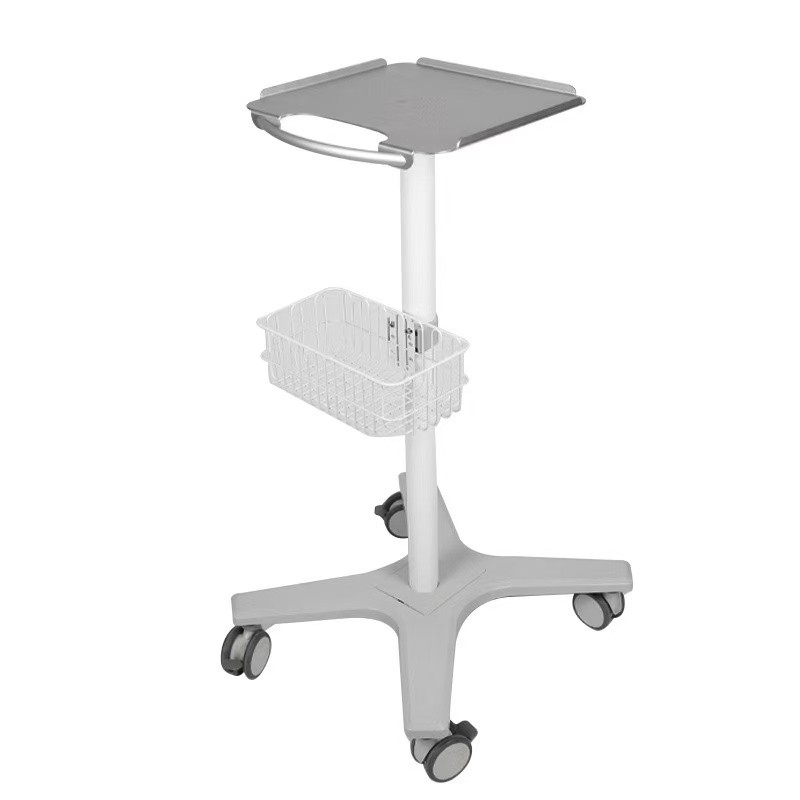
Patient transfer trolleys — in standard and height-adjustable high-low variants — are essential for safely moving patients between imaging, theatre, recovery, and ward areas. The high-low mechanism is particularly important: it allows the trolley surface to align precisely with a bed or operating table, eliminating the lateral transfer gap that causes both patient discomfort and staff injury. Emergency and crash cart trolleys, by contrast, are designed around rapid access. Every drawer, shelf, and compartment follows a standardised layout so that in a resuscitation scenario, any trained clinician can locate equipment in seconds regardless of which unit they are working in. Surgical dressing trolleys and instrument trolleys serve the sterile field in procedure rooms, while ECG, diathermy, and infusion pump stands keep diagnostic and therapeutic devices mobile so clinicians can bring technology to the bedside rather than moving the patient. Finally, operational trolleys — linen, goods, service, and cylinder trolleys — keep the hospital’s supply chain running cleanly and safely, with dedicated units for clean and soiled materials preventing cross-contamination in corridors.
Just as no single bed suits every patient, no single trolley design suits every clinical task. The variety is intentional, and sourcing from an experienced hospital furniture manufacturer ensures that each trolley category meets the load ratings, surface finish standards, and mobility specifications required for its specific clinical application.
Matching Furniture to Facility: The Value of a Customised Approach
No two health facilities are identical. A rural primary care clinic procuring its first set of ward beds has different structural constraints, budget parameters, and patient volumes than a 300-bed urban referral hospital expanding its ICU. This is where a supplier with deep manufacturing expertise and genuine flexibility makes a measurable difference. Anyang Top Medical Devices Co., Ltd provides precisely this kind of end-to-end support, working with health facilities to understand the unique clinical requirements of each department and delivering beds, trolleys, and ancillary furniture that are specified and manufactured to match. From mattress depth and rail configuration on a 5-function bed to the drawer layout and surface coating on a surgical instrument trolley, each item is designed and built to the facility’s own clinical and operational brief — not as an off-the-shelf compromise.
For procurement teams and facility planners, this level of customisation translates directly into long-term value: equipment that fits the space, matches the workflow, and holds up to the specific demands of the environment it was built for. Whether a health facility is equipping a single ward or furnishing an entire new campus, the principle remains the same — generic furniture creates generic outcomes, while purpose-matched clinical furniture supports genuinely excellent care.
The Digital Workflow Parallel: Customisation in Modern Dentistry
The logic of customisation extends well beyond hospital furniture. In modern dental practice, every patient’s oral anatomy is unique — no two arches, occlusions, or implant sites are the same. A dentist today uses an intraoral digital impression scanner to capture precise three-dimensional data of the patient’s mouth, then shares that data directly with a dental laboratory. There, a skilled technician loads the digital file into a 3D dental printer, which fabricates patient-specific outputs: accurate oral models for treatment planning, surgical guides for implant placement, and provisional crowns that fit the individual patient’s anatomy from the first try. The result is faster turnaround, less manual adjustment, and outcomes tailored to the person in the chair rather than an average. In this sense, the high resolution of 30μm XY precision dental 3D printer is no longer a luxury — it is a must-have piece of equipment in any modern dental laboratory that takes precision and efficiency seriously.
Conclusion
Whether the context is a hospital ward or a dental laboratory, the underlying principle is the same: the best clinical outcomes are built on equipment that is designed for the specific person and the specific task. For health facility planners, investing thoughtfully in the right range of beds and trolleys — and partnering with the right hospital furniture manufacturer — is not a procurement detail. It is a foundational act of patient care.